Outside of Naples, I can't think of a better place to learn about Neapolitan pizza than in NYC, the birthplace of pizza in America.

The same week I signed up for
Scott's Pizza Tour in NYC in January 2013, I also contacted
Giulio Adriani, recommended by a member of the Pizza Making Forum (PMF), as another great resource in making Neapolitan pizzas. Giulio is the chief pizzaiolo and owner of
Forcella, who happens to be one of the Senior Pizza Makers in the
AVPN.
AVPN is an organization created to protect the professionalism of the pizza makers in Italy and worldwide that choose to make the True Neapolitan Pizza according to the tradition and to ensure the quality of the production process and products used.
I really didn't know much about Giulio as an instructor, other than the fact that he has taught classes as far places as Brazil and that members of the PMF raved about the incredible pizzas at Forcella. Amazing what you can find in the Internet. I contacted Giulio though his
Forcella website and got an immediate response. Evidently, he is open to sharing his knowledge so I set up a one-on-one training with him.
It turned out that Giulio was stuck in Naples on the day we were suppose to meet. But we were able to reschedule our meeting at the Brooklyn restaurant on a Saturday morning well before the pizzeria doors opened to the public. Our lesson began with an inquiry of my current experience. I explained my success with Ken Forkish's pizza recipes, one with a poolish overnight dough with a 75% hydration, and an
overnight dough with 70% and my latest experimentation with a 68% hydration recipe that I found on the PMF.
 |
| Forcella in Brooklyn |
May I digress for a moment? I'm all about learning hands on. I consider myself a visual learner, and most especially with dough. I attempted baking bread twice on my own with little success, and found trial and error to be quite costly with good ingredients. I felt as though bread books were written in Greek. I could not translate the words as to how the dough was suppose to look or feel. I had early success in baking bread, not by reading more cook books but by attending a hands-on workshop,
Artisan Bread School with Carl Shavitz. I find watching a master baker knead the dough at my side and then doing so myself certainly accelerated my learning. After a week with Carl, I was easily able to translate the recipe instructions and bake breads from my favorite bakers with success! Taking his course gave me a fuller understanding of bread dough and fermentation. By the same token, I knew that meeting another master baker would do wonders for my grasp of learning the art and science of Neapolitan pizza making. In the interest of the cooks and bakers new to pizza making or "noobs", as my 10-year old would say, I hope that this post will offer insightful information for those interested in this culinary tradition and delight of Naples.
 |
Giulio Adriani
|

Giulio is very much an open book with his pizza making and a great ambassador to the craft. Giulio showed up at the Brooklyn pizzeria a few minutes after I did, looking more like a stylish model with a scarf around his neck, than a pizza maker. As a good instructor should do, Giulio was interested to find out the baseline with what he had to work with. I explained to him that I had been experimenting with pizza recipes since October up until the previous week, and ready to learn a new kind of pizza.
After changing into an oversized
Caputo (flour brand) shirt and apron and feeling official, we headed to the downstairs kitchen where dough is made daily. Starting with the basics, I would learn to make dough, by hand. There were several stainless steel benches in the middle of the room, next to the walk-in refrigerator, a mammoth mixer, and heavy stacks of
Caputo 50 pound bags of flour on the floor. The recipe for making Neapolitan pizza is no secret. The recipe is clearly explained in the AVPN documentation. Giulio explained the percentages of ingredients and what worked for him, with strong consideration of the ambient temperature and humidity in the room, and how it affects fermentation, which in turn will result in the outcome: the flavor and texture that is found in a Neapolitan pizza.
Giulio began to weigh each ingredient using a digital scale. Unlike cooking, baking breads and cakes including pizza requires exactness of measurement. This is probably one aspect I love about making pizza, measuring for accuracy. However, depending on the ambient temperature and humidity, the pizza maker can make minor adjustments to the amount of yeast and/or salt. Next to Giulio, I did the same measurements and followed along. Giulio showed me his staging process technique (the order in which ingredients are mixed). We mixed everything in a stainless steel bowl, and when the dough looked "shaggy", we transferred the mass onto the countertop. Then came the hard part. Kneading the dough, punching the dough, alternating side to side, until the dough mass became soft and supple. Instructions were easy to follow; the idea of simulating the fork mixer with both hands, punching the sides of the dough from opposite direction was a challenge. I realized it would be a matter of time to building Popoye forearm muscles to make this an easier step.
Once we kneaded the dough to the right consistency, he showed me how to portion the dough balls. The guideline to make dough balls is measuring approximately 250 grams. After weighing several dough balls, he showed me how to form round balls. Using one hand, rotating the ball clockwise rounds the dough into a sphere. Using both hands, two balls can be formed at the same time which is common for pizza makers to handle. In fact, the pizza makers who make dough all day can eye-ball the dough without even using a scale.
Giulio showed me a trick of cutting the dough into log shape and pinching an amount approximating the correct portion and molding a sphere with both hands, very similar to how mozzarella is shaped into balls. It's folding the dough out and bringing it to the edges and pinching the ends so that it stays closed and round. Capische?
 |
Like a mozzerella ball
|
I look over to Pequeno, one of Giulio's hard-working staff, glancing my way, smiling and probably thinking why this crazy lady is spending a beautiful January morning cooped up in the kitchen making dough balls. Needless to say, kneading dough is one of my favorite aspects of pizza making. I actually find it very relaxing and a pleasant way to decompress. The nerdy part of me enjoys the exactness of measuring ingredients with a digital scale. The creative side of me loves the tactile experience of squeezing dough between my fingers.
We repeated the entire process: measuring ingredients, mixing ingredients, kneading dough and portioning into dough balls prior to the second fermentation process. We returned upstairs to the front of the restaurant where the pizza oven is. A nice break for my sore forearms! One of my favorite aspects of pizza making, is being close to the fire. I love the heat that comes from the pizza oven! Working in my day job (the operating room) where the temperature is around 63 degrees, I welcome being near the hot dome.
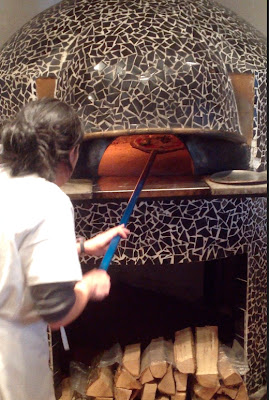 |
Loving the warmth
|
Giulio explains oven management and offered expert advice which I absorbed like a sponge. The pizza books I have on hand give instructions on how to bake using a home oven, but not a wood-fire oven. A piece of advice he gave me was a eureka moment for me, yet it just made perfect sense. After cooking a pizza on one side, you turn it 180 degrees to the other side, and in doing so, you want to return the pizza back to the same place on the hearth you removed it from. Returning the pizza to the same "cool" spot will finish cooking the bottom of the pie. But if you put the in a new spot, the half-cooked pie will burn on the bottom before the top is cooked. Capische?
Giulio explained his methodical ways of removing dough balls from the tray. It is through this meticulous care of lifting dough balls out of the tray that there are minimal-to-no changes to the shape of the fermented dough.
 |
Lift dough
|
Most folks are familiar with pizza makers using their knuckles to stretch out the dough, or both arms to toss the pizza into midair. However, with Neapolitan pizza, the key technique, while maintaining the round shape of the fermented dough, is to push the air away from the center of the base, towards the edge. This method provides the billowy texture and the "cornicione" (rim), the hallmark appearance of the Neapolitan pizza.
 |
Gently "push" air towards the rim
|
The other key technique, known as the "Neapolitan Slap", helps stretch the dough to an appropriate thickness. The slap is really a misnomer. It's a rhythmic motion between both hands, moving the dough between hands while gently stretching and turning the dough base ninety degrees. I found this to be the most challenging part for me. Eventually I would get the hang of it and did well until I started thinking about what I was doing!
 |
| Gently pull dough with left hand... |
 |
| Fold dough over the right wrist... |
An important aspect of pizza making is the transfer of dough to the peel and from the peel to the oven floor (hearth). The dough is stretched about eighty percent on the counter, dressed with toppings, and then gently pulled onto the peel. While on the peel, the dough is stretched some more, pulling from the base and keeping away from the rim.

 |
Final stretch on the peel
|
I continued to practice stretching the dough and then dressing it with "mock mozzerella", which is cut-up pizza crusts. Doing so simulates the weight of the cheese, thereby preventing the expansion of the Neapolitan crust (namely, a naan).
In the last forty-five minutes of my training, I had several exercises to accomplish. An exercise of stretching and dressing two pizza doughs at once and then cooking them at the same time. That was definitely easier than three pizzas at once. Needless to say, it was quite fun! I also got to make a Pizza Montanara which Giulio first introduced to the city. It is a pizze fritte, where the dough is lightly flash fried, dressed and then quickly finished in the wood-fire oven.
The next evening, I took my family to the Forcella pizzeria in Bowery. I got to stretch the dough, dress, and cook the pizzas!! I had nervous energy and excitement to have the opportunity to cook dinner for the family. Thank you, Giulio, for the great idea! I passed the test - the kids loved the pizzas!
 |
"Remember to be gentle, Sharlene"
|
 |
Kids are hungry tonight!
|
All in all, I had the best learning experience with Giulio. He is very patient and skilled as an instructor. He is very talented at explaining the methods and techniques in words that I understand. Also, he clearly explains the rationale for a technique or method that he is doing. Just what the adult learner like myself needs.
 |
Pizza Night at Forcella
|
In the slow, cold months of January, you can go to Forcella for dinner and "make your own pizza". With Giulio's help, he will help you open the dough, and you get to choose your toppings. He was available one evening in the Park Avenue pizzeria, and another night in Brooklyn. Talk about a private lesson! I suppose depending on how serious you are with pizza, it is an opportunity to meet with Giulio and pick his brain about pizza making.
 |
"Check the bottom of the pizza..."
|
NOTE: My one-on-one training with Guilio took place in January 2013. Due to a hectic travel schedule and late winter weather conditions, I wasn't able to try my newly learned techniques and recipe until April when firing up the wood-fire oven outside was tolerable. Needless to say, I was very happy with the results!
 |
Pizza making at home
|
 |
Charlottesville, VA is ready for this!
|
New adventures are underway in Forcella! In collaboration with the Associazione Pizzaiuoli Napoletani President Sergio Miccu, and the sponsor of
Caputo Flour, the new
Pizza Academy will open to pizza professionals as well as home baker chefs. All types of authentic pizza will be taught including the pizza al metro, according to Giulio.
 |
Pizza al Metro
|
I met up with Giulio in March at the
Pizza Expo and then again in May, and he generously gave his time to help me with the video portion of my Kickstart Campaign. More details on another blog post about my new project! It wasn't until after I took the training class that I realized how passionate he is with the craft. He's been in the pizza business for thirty years, making pizzas in Naples well before he came to NYC. After successfully opening three pizzerias in New York as he continues to teach and consult, he is continuing to conquer his dream of introducing authentic Neapolitan pizza to the palates of uncharted places.
 |
Me and Giulio
|
 |
Pizza Margherita at Forcella (Bowery)
|


 Giulio is very much an open book with his pizza making and a great ambassador to the craft. Giulio showed up at the Brooklyn pizzeria a few minutes after I did, looking more like a stylish model with a scarf around his neck, than a pizza maker. As a good instructor should do, Giulio was interested to find out the baseline with what he had to work with. I explained to him that I had been experimenting with pizza recipes since October up until the previous week, and ready to learn a new kind of pizza.


