Translate

Showing posts with label Giulio Adriani. Show all posts

Saturday, November 2, 2013

So You Wanna be a Pizzaiolo: Pizza Trainining & Getting Certified - Reality Check!

Authentic Neapolitan Pizzeria


Neapolitan pizza is the latest rage in the pizza food industry.  Pizzerias specializing in this culinary delight of Naples are springing up in major cities like Los Angeles, Dallas, Atlanta, Chicago, to name a few, throughout the country. As a member of Pizza Making Forum, I read of members wishing they could quit their day job and work their dream job of being a full-time pizzaiolo, and others who already have pizza skills or bread baking experience and want to venture out in the Neapolitan pizza business.

While I had neither aspirations early in January, I'm all about learning a new craft,  finding the best resources, cost effective training, and getting the best hands-on experience. Reading my earlier blogs, you'll know how Scott's Pizza Tour exposed me to the flavors of Neapolitan pizza.  It was also Scott who convinced me to take Roberto Caporuscio's training in the city by living and breathing pizza for 10 straight days.  As an avid learner of any form of creativity and "who knows, a pizzeria could be in the future,"  I easily convinced myself to take the plunge and involve myself with "getting certified".

Clearly, it's good to have choices in making any decision. This post will be useful to others who are thinking about what it takes to be a certified Neapolitan pizzaiolo (pizza maker).

This blog is dedicated to my personal experiences with anything related to pizza. And you will see that it's specific to Neapolitan pizza making.  The attraction is because it's the closest process to artisan bread baking, i.e. fermentation.  Also, it's the only pizza making tradition that requires adherence to a specific guideline set forth by the Italian governing body. Here are several acronyms I came across that I needed to google for clarification.  So the Italian governing body that provides these guidelines is Associazione Verace Pizza Napoletana (AVPN) which is housed in Naples.  VPN Americas is the official American Delegation of The AVPN, is headquartered in Marina del Ray, CA and is currently responsible for the US and Canada market. Then there is APN Americas. Yet,  I am not clear as to who or what empowered APN to certify individuals.

 For clarity, there is a distinction between the two certifications.  AVPN certification is given to the pizzeria who show that they adhere to the AVPN rules. This means the pizzeria has met the basic requirements of using a wood fire oven, proper ingredients, equipment and proper technique for preparation of dough and pizza.  In addition to the application form, a video showing the process of making the dough/pizza is required. AVPN Certification is given to the individual pizza maker.  To date, food trucks with a pizza wood fire oven business are not certifiable.  Maybe that will change.

My Baking Background:

Baking has always been one of my many favorite activities.  Like most young teenagers, I was drawn to baking anything sweet like cookies, cakes, quick breads, muffins, tea cakes, and cupcakes. In my forties, it's been all about artisan bread baking.   I took an artisan bread course and learned about fermentation and how to cultivate a starter.  Learning to use natural leaven with sourdough breads, focaccia and seeded breads  expanded my bread making skills and whetted my appetite to try recipes from Jeffrey Hammelman, my bread hero. My bread background is what attracted me to learning Neapolitan pizzas which involves the fermentation to achieve flavor and texture. I was attracted to the idea of making pizza dough with my bare hands, as opposed to a mixer or rolling pin.

Focaccia using natural leaven


Rosemary and Sea Salt


My Pizza Making Experience:

Back in November, 2012, I signed up to be  a member of the Pizza Making Forum; a great exposure to vast opinions, countless recipes, pizza experiences, and a great way to connect with pizza fanatics all over the globe who are pizza makers at home, professionals and the wannabees. To date, there are over 20,000 members.  It was through this forum that I was able to find Giulio Adriani, a restaurant owner/pizza chef of Forcella and teach me the fundamentals of Neapolitan pizza.  After attending the Pizza Expo and learning more about pizza science from another pizza chef, Tony Gemignani, I continued my training with Roberto Caporuscio, pizza chef of Keste / Don Antonio.


Making pizzas at Forcella with Giulio Adriani

While I would love to  continue to pursue more pizza training in Naples, I've reached a point where I need to practice the art and science of pizza making on my own.


After this Training Experience, Would I do Anything Different?

Prior to my first hands-on lesson of Neapolitan pizza making with Giulio Adriani, I spent  quality time watching videos on You Tube.  In fact, I highly recommend "Pizza Training with the Masters, Part 1, Part 2, and Part 3.  It is a professionally made video of Roberto Caporuscio and Peppe Starita discussing dough management including making mozzarella.   Watching these informational videos prepared me for the hands-on training with Giulio Adriani in January 2013.  By the time I started my training with Roberto in May 2013, I honestly felt like I was paying an exorbitant amount of cash just so I could help make dough for his customers because he was understaffed, and simply to use and experience  his professional kitchen.  Unless your goal is to open a Neapolitan pizzeria, taking a 10-day pizza training course with Roberto Caporuscio and getting certified is a complete overkill.  Even for the experienced baker, five days is sufficient.

Based on my personal experience, Roberto seems to explain himself better in front of the camera rather than in person.  It's really tough to get any personal attention from the pizza master, when he is distracted with his cell phone, Skype, computer, or staff.  Save the other five days and invest in the equipment or supplies! A fork mixer is not cheap, so invest wisely! And IF you must train with Roberto, make sure his daughter, Georgia, who helps him teach the dough and oven management is around.  She travels to Italy often, and it would to your advantage in making sure she's doing the training. Her English explanations are easier to understand regarding the "Starita technique" of gently opening the dough.


For the novice, enthusiasts, pizza makers who already make other styles, do yourself a favor and be a member of Pizza Making Forum,  read the Serious Eats: Slice Pizza Blog which offers information about ANY pizza you can imagine, watch the FREE and amazing videos on You Tube, and contact Giulio Adriani  for additional training or consultation.  If you want to be certified, VPN Americas is a more reasonable investment.  Three days. Their website has a syllabus which explains in detail the what the student is expected to learn.

VPN Americas


So, Is One Training Better than Another?

Here's a post I found on the Forno Bravo website who shares their personal experience learning to make Neapolitan pizza in Naples. By the way, Forno Bravo is website that includes a forum where folks can seek out information on pizza related issues. They have forum where folks share their experience in building their own pizza oven.

My name is Michael Fairholme and I work with James at Forno Bravo. In January and February of this year I spent 4 weeks with a Master Pizziolo in Napoli to perfect my techniques and I think I can answer most of your questions.

First, I've only found one trainer in Napoli that takes foreign students, all other pizza training courses are designed and run for the local talent and you must speak Italian. My trainer was Enzo Coccia and his business is called Pizza Consulting and it's run from La Notizia, his pizzeria in a suburb of Napoli. The course in 3 weeks long and will cost about 1500,00 euros. He sometimes allows students to extend for a week if other students have started their training somewhere in the middle or end of yours. The classes are only taught in Italian but he has a young lady that will act as an interpreter for 60,00 euros per day. Enzo suggests you have her for the first four days of your training, because after that a 'pizza' vocabulary develops and you'll can get most of what he's trying to teach by sign language and a lot of shouting.

The best time of year is any time...Napoli is beautiful and if you get out and explore it is a great place to visit. Bare in mind Enzo closes the month of August.

How you register is through his website: pizzaconsulting.it
He is a bit slow to respond and it will be done through Nika his interpreter.

I found a very nice, clean hotel about a 25 minute walk from the pizzeria that cost 30,00 per night (bathroom down the hall), Enzo has a friend that can supply a room in his house for about the same money but it's miles away and you will not be able to see any of the City living so far out of town. There are two other 2 star hotels a bus ride away that charge 50-60,00euros per night - I can give you more specifics later.

Now, what will you actually learn? This my second visit to Enzo, the first was April of 2006 and I only stayed for 6 days. My purpose then was to gain enough knowledge to help a client open a Vera Pizza Napoletana restaurant in Athens, Greece. I had recruited a young man with good wood-burning oven experience, I just wanted to bend his skills toward what my client wanted...true, thin crusted pizza Napoletana. In the end, my first few days gave me enough information to get open and make a very good pizza, but when time allowed, I went back for the full three weeks to perfect my technique. I'm glad I had a chance to go twice with a break in between, because we had moved off center a bit and the second three weeks brought me back on course. You will definitely learn how to make Vera Pizza Napoletana. The initial focus is learning about the dough...the most important part. Everyday you will make dough, at first it's a 2kg batch made by hand, then you move up to the automatic mixer making 10kg batches. Then you'll learn how to form the "pignotte" , the pizza ball which will later be formed into the pizza round. Next you'll learn how to form the pizza round, probably the most tricky part - everyone struggles with this. Then you'll learn pizza peel techniques, control, placing the pie, pulling, placing in a take-away box, placing on a plate. Then you learn how to fire the oven and get it to temperature and then manage the fire. Next you learn how to make sauce and cut cheese. Now you learn to make pizza Margherita and pizza Bianca. And that's about it, anything else you learn will be from watching Enzo and his staff during evening service and any other visits you can make to VPN pizzerie around Napoli and there are several hundred to choose from.

Now for the drawbacks. First, the class is only four hours long, 3 1/2 really because he never arrives on time, we take a 20 minute coffee break to give the dough a chance to rise, and he always stops at least 20 minutes early so you can clean the pizzeria for evening service. You need to learn a lot in this small amount of time and there just isn't enough time to practice each of these very important skills, especially if there are 3 or 4 people in the class...you get even less one-on-one. The place is so small there can only be one student in the pizzeria during evening service, so even being able to watch people doing what you so desperately want to learn is tough. For at least 5 days of the 3 weeks course, you'll come back to the pizzeria to chop and dice ingredients for that nights service. After a while you get the feeling that you're just free labour as they tell you to sweep the floor, or go get wood from the storage unit. But it does give you a good understanding of how you'll organize your own place so I shouldn't grumble. You don't actually get to make a pizza until the last day of the last week and then it will be a Margherita, a Marinara and a Pizza Bianca. As a result, from lack of any practice time, you struggle with your turning technique, your rounds are more oval and thinner than they should be...in general, you just don't get enough oven time to prepare you for your own place. Considering I paid 1500,00 plus 240,00 for the interpreter, airfare was 975,00, hotel, food and tickets for the bus and taxis was an additional 60,00 per day ( and that was done on the cheap) which adds 1260,00 to the total, I had 4000,00 euros/$5400.00 invested before I considered my loss of income for 5 weeks; that's a lot of money for a 52.5 hour training course.

The positives: I really feel like I understand the dough and have a good knowledge of the water to flour ratios, I understand and respect the traditions behind Pizza Napoletana, I know what is required to make this style of pizza, and I understand the rules and have experienced how the quality of ingredients makes this pizza so special. If you get it right this pizza is magic!

So, 1000 words later, I love this pizza and I'm sure I know how to do it, but only because I had an oven and mixer in Athens to return to so I could continue to practice, practice, practice. As for being able to come back and run a pizzeria, I only gained that by visiting 35+ pizzeria in Napoli, Roma, Firenze and Milano, watching how they did it, took notes on how they laid out there make table and positioned their ovens. I watched as staff handled a 30 pie rush, worked as a team (or didn't, which was often the case) and took notes on where to put the fridge units. Combine all this with my time at La Notizia and now I feel I can open a pizzeria...or yours if you want some help!


While this is one account of someone's experience, there is no "perfect" training or class.
Learning in Italy would be a dream, however, the translation, even with a translator, may be a challenge. (More on this experience with another blog post learning from Gabriele Bonci via a translator in Eataly!).  But the idea of learning to make pizza from THE place, the opportunity to taste pizzas all around the city and watch the pizzaiolos do their magic would be an amazing experience.

Roberto Caporuscio who intially trained with Enzo Coccia, is now under the tutelage of Antonio Starita, better known for handling the dough more gentler than Enzo Coccia.  Yet, there is no mistake that Neapolitan pizza chefs like Enzo Algarme of Pupatella in Arlington, VA;  Brad Otton of Setto Bello in NV; and  Jonathan Goldsmith of Spacca Napoli, in Chicago, IL trained under Enzo Coccia. Jay Jerrier of Il Cane Rosso in Dallas, TX and Anthony Carron of 800 Degrees, in Los Angeles both received their technical training from VPN Americas in Marina del Rey, CA. As you can imagine, there is no one path to acquiring the skills and technique needed to adhere to the AVPN and being a success story in the Neapolitan pizza business. Interesting to note that both Enzo Algarme of Pupatella and Jay Jerrier of Il Cane Rosso started out as a food truck / oven trailer business.  Evidently, their small business led them to a brick and mortar location(s) with much success!

I say it's all about getting the basic fundamentals of Neapolitan pizza making under your belt, learning not from one but as many as possible, practicing the craft, remaining passionate, and being able to create a Neapolitan pizza that will provide someone their best experience!!

What's next?  Practice, practice and more practice for me! Thanks to neighbors, friends,  and work colleagues, they brought their appetites and enthusiasm to indulge my passion for making the "perfect" Neapolitan pizza! Looking forward to spring time when I can fire up the wood fire oven for another pizza party. For the time being, my beloved Le Panyol oven (on a stand) is for sale so that I can get a mobile wood fire oven and bring Neapolitan wood fire pizzas to the Charlottesville community.


Potatoes with rosemary, swiss and gruyere cheese


Fennel Sausage with basil and fresh mozzarella


Shiitake and cremini mushrooms with truffle cheese


Trying my hand with  Pizza della Romana


So You Wanna be a Pizzaiolo (pizza maker)? Here are names and schools that I found during my search on the internet.

USA:

VPN Americas ( Peppe Miele and Jose Barrios, Marina del Ray, California)
3-day course ($1650)
5-day course ($2650)
VPN certification

International School of Pizza (Tony Gemignani, San Francisco, California)
4-day course; VPN certification
1-day course for Home Chef

Pizza Academy (Forcella, Brooklyn, New York, Giulio Adriani) - OPENING SOON
5-day course; VPN certification
1-day course for Non-Professional

Pizza Training (Don Antonio, New York, Roberto Capuroscio)
10-day course ($4500)
APN certification

Carmine D'Amato Neapolitan Pizza Lessons ( Settebello, Henderson, NV)
3-day course ($1200)
6-day course ($2000)
10-day course ($2800)

Wood Fire Oven Baker (Ellie Olsen, Colorado)
Supplier of Neapolitan ovens, mixers, pizza prep tables, etc.
Test Kitchen Available

Artisan Pizza Solutions  (Michael Fairholme, California)
In-house pizza training

Italy:

AVPN School of Pizza Training

Pizza Consulting / Training with Enzo Coccia (Naples, Italy)

Franco Pepe ( Caiazzo, Campania, Italy)
Antica Osteria Pizzeria Pepe
francopepe18@alice.it

Gennaro Esposito

Scuola Italiana Pizzaioli:
Graziano Bertuzzo, instructor
Angelo Silverstrini, instructor

Gino Sorbillo


Wednesday, June 12, 2013

bufala! PIZZA NAPOLETANA: KickStarter Launches Today!


bufala! PIZZA NAPOLETANA KickStarter launches today!  Check out my video that summarizes my passionate vision and goals in sharing the authentic taste of Neapolitan pizza. The project description of my campaign explains in detail: what makes Neapolitan special, the professional training I received, the funding needed to succeed in order to bring the authenticity of Neapolitan pizza to you! Also, check out the great Rewards for supporters!


We have 30 days to reach our goal. Thank you in advance for your support!!

http://www.kickstarter.com/projects/bufalapizza/bringing-authentic-neapolitan-pizza-to-central-vir

Sharlene

Thursday, May 30, 2013

Best One-On-One Pizza Training with Giulio Adriani, pizza chef/owner of Forcella di Napoli


Outside of Naples, I can't think of a better place to learn about Neapolitan pizza than in NYC, the birthplace of pizza in America.


The same week I signed up for Scott's Pizza Tour in NYC in January 2013, I also contacted Giulio Adriani, recommended by a member of the Pizza Making Forum (PMF), as another great resource in making Neapolitan pizzas. Giulio is the chief pizzaiolo and owner of Forcella, who happens to be one of the Senior Pizza Makers in the AVPN.  AVPN is an organization created to protect the professionalism of the pizza makers in Italy and worldwide that choose to make the True Neapolitan Pizza according to the tradition and to ensure the quality of the production process and products used.

I really didn't know much about Giulio as an instructor, other than the fact that he has taught classes as far places as Brazil and that members of the PMF raved about the incredible pizzas at Forcella. Amazing what you can find in the Internet. I contacted Giulio though his Forcella website and got an immediate response. Evidently, he is open to sharing his knowledge so I set up a one-on-one training with him.

It turned out that Giulio was stuck in Naples on the day we were suppose to meet. But we were able to reschedule our meeting at the Brooklyn restaurant on a Saturday morning well before the pizzeria doors opened to the public. Our lesson began with an inquiry of my current experience. I explained my success with Ken Forkish's pizza recipes, one with a poolish overnight dough with a 75% hydration, and an overnight dough with 70% and my latest experimentation with a 68% hydration recipe that I found on the PMF.
Forcella in Brooklyn

May I digress for a moment? I'm all about learning hands on. I consider myself a visual learner, and most especially with dough. I attempted baking bread twice on my own with little success, and found trial and error to be quite costly with good ingredients. I felt as though bread books were written in Greek. I could not translate the words as to how the dough was suppose to look or feel.  I had early success in baking bread, not by reading more cook books but by attending a hands-on workshop, Artisan Bread School with Carl Shavitz. I find watching a master baker knead the dough at my side and then doing so myself certainly accelerated my learning. After a week with Carl, I was easily able to translate the recipe instructions and bake breads from my favorite bakers with success! Taking his course gave me a fuller understanding of bread dough and fermentation. By the same token, I knew that meeting another master baker would do wonders for my grasp of learning the art and science of Neapolitan pizza making. In the interest of the cooks and bakers new to pizza making or "noobs", as my 10-year old would say, I hope that this post will offer insightful information for those interested in this culinary tradition and delight of Naples.

Giulio Adriani

Giulio is very much an open book with his pizza making and a great ambassador to the craft. Giulio showed up at the Brooklyn pizzeria a few minutes after I did, looking more like a stylish model with a scarf around his neck, than a pizza maker.  As a good instructor should do, Giulio was interested to find out the baseline with what he had to work with. I explained to him that I had been experimenting with pizza recipes since October up until the previous week, and ready to learn a new kind of pizza.

After changing into an oversized Caputo (flour brand) shirt and apron and feeling official, we headed to the downstairs kitchen where dough is made daily. Starting with the basics, I would learn to make dough, by hand. There were several stainless steel benches in the middle of the room, next to the walk-in refrigerator, a mammoth mixer, and heavy stacks of Caputo 50 pound bags of flour on the floor. The recipe for making Neapolitan pizza is no secret. The recipe is clearly explained in the AVPN documentation.  Giulio explained the percentages of ingredients and what worked for him, with strong consideration of the ambient temperature and humidity in the room, and how it affects fermentation, which in turn will result in the outcome: the flavor and texture that is found in a Neapolitan pizza.

Giulio began to weigh each ingredient using a digital scale. Unlike cooking, baking breads and cakes including pizza requires exactness of measurement. This is probably one aspect I love about making pizza, measuring for accuracy. However,  depending on the ambient temperature and humidity, the pizza maker can make minor adjustments to the amount of yeast and/or salt. Next to Giulio, I did the same measurements and followed along. Giulio showed me his staging process technique (the order in which ingredients are mixed). We mixed everything in a stainless steel bowl, and when the dough looked "shaggy", we transferred the mass onto the countertop. Then came the hard part. Kneading the dough, punching the dough, alternating side to side, until the dough mass became soft and supple. Instructions were easy to follow; the idea of simulating the fork mixer with both hands, punching the sides of the dough from opposite direction was a challenge. I realized it would be a matter of time to building Popoye forearm muscles to make this an easier step.

Once we kneaded the dough to the right consistency, he showed me how to portion the dough balls.  The guideline to make dough balls is measuring approximately 250 grams. After weighing several dough balls, he showed me how to form round balls. Using one hand, rotating the ball clockwise rounds the dough into a sphere. Using both hands, two balls can be formed at the same time which is common for pizza makers to handle. In fact, the pizza makers who make dough all day can eye-ball the dough without even using a scale.

Giulio showed me a trick of cutting the dough into log shape and pinching an amount approximating  the correct portion and molding a sphere with both hands, very similar to how mozzarella is shaped into balls. It's folding the dough out and bringing it to the edges and pinching the ends so that it stays closed and round. Capische?

Like a mozzerella ball

I look over to Pequeno, one of  Giulio's hard-working staff, glancing my way, smiling and probably thinking why this crazy lady is spending a beautiful January morning cooped up in the kitchen making dough balls. Needless to say, kneading dough is one of my favorite aspects of pizza making. I actually find it very relaxing and a pleasant way to decompress. The nerdy part of me enjoys the exactness of measuring ingredients with a digital scale. The creative side of me loves the tactile experience of squeezing dough between my fingers.

We repeated the entire process: measuring ingredients, mixing ingredients, kneading dough and portioning into dough balls prior to the second fermentation process. We returned upstairs to the front of the restaurant where the pizza oven is. A nice break for my sore forearms! One of my favorite aspects of pizza making, is being close to the fire.  I love the heat that comes from the pizza oven!  Working in my day job (the operating room) where the temperature is around 63 degrees, I welcome being near the hot dome.

Loving the warmth


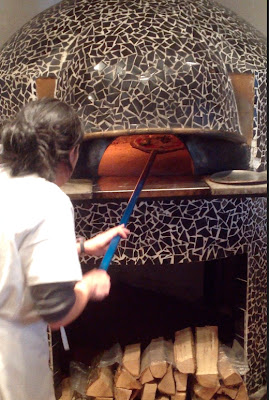
Giulio explains oven management and offered expert advice which I absorbed like a sponge. The pizza books I have on hand give instructions on  how to bake using a home oven, but not a wood-fire oven. A piece of advice he gave me was a eureka moment for me, yet it just made perfect sense. After cooking a pizza on one side, you turn it 180 degrees to the other side, and in doing so, you want to return the pizza back to the same place on the hearth you removed it from. Returning the pizza to the same "cool" spot will finish cooking the bottom of the pie. But if you put the in a new spot, the half-cooked pie will burn on the bottom before the top is cooked. Capische?

Giulio explained his methodical ways of removing dough balls from the tray.  It is through this meticulous care of lifting dough balls out of the tray that there are minimal-to-no changes to the shape of the fermented dough.

Lift dough


Most folks are familiar with pizza makers using their knuckles to stretch out the dough, or both arms to toss the pizza into midair. However, with Neapolitan pizza, the key technique, while maintaining the round shape of the fermented dough, is to push the air away from the center of the base, towards the edge. This method provides the billowy texture and the "cornicione" (rim), the hallmark appearance of the Neapolitan pizza.

Gently "push" air towards the rim

The other key technique, known as the "Neapolitan Slap", helps stretch the dough to an appropriate thickness.  The slap is really a misnomer.  It's a rhythmic motion between both hands, moving the dough between hands while gently stretching and turning the dough base ninety degrees. I found this to be the most challenging part for me.  Eventually I would get the hang of it and did well until I started thinking about what I was doing!

Gently pull dough with left hand...


Fold dough over the right wrist...


An important aspect of pizza making is the transfer of dough to the peel and from the peel to the oven floor (hearth).  The dough is stretched about eighty percent on the counter, dressed with toppings, and then gently pulled onto the peel. While on the peel, the dough is stretched some more, pulling from the base and keeping away from the rim.


Final stretch on the peel

I continued to practice stretching the dough and then dressing it with "mock mozzerella", which is cut-up pizza crusts. Doing so simulates the weight of the cheese, thereby preventing the expansion of the Neapolitan crust (namely, a naan).

In the last forty-five minutes of my training, I had several exercises to accomplish. An exercise of stretching and dressing two pizza doughs at once and then cooking them at the same time. That was definitely easier than three pizzas at once. Needless to say, it was quite fun!  I also got to make a Pizza Montanara which Giulio first introduced to the city. It is a pizze fritte, where the dough is lightly flash fried, dressed and then quickly finished in the wood-fire oven. 

The next evening, I took my family to the Forcella pizzeria in Bowery. I got to stretch the dough, dress, and cook the pizzas!! I had  nervous energy and excitement to have the opportunity to cook dinner for the family. Thank you, Giulio, for the great idea! I passed the test - the kids loved the pizzas!

"Remember to be gentle, Sharlene"

Kids are hungry tonight!

All in all, I had the best learning experience with Giulio. He is very patient and skilled as an instructor. He is very talented at explaining the methods and techniques in words that I understand. Also, he clearly explains the rationale for a technique or method that he is doing. Just what the adult learner like myself needs. 

Pizza Night at Forcella

In the slow, cold months of January, you can go to Forcella for dinner and "make your own pizza". With Giulio's help, he will help you open the dough, and you get to choose your toppings. He was available one evening in the Park Avenue pizzeria, and another night in Brooklyn. Talk about a private lesson! I suppose depending on how serious you are with pizza, it is an opportunity to meet with Giulio and pick his brain about pizza making. 

"Check the bottom of the pizza..."

NOTE:  My one-on-one training with Guilio took place in January 2013. Due to a hectic travel schedule and late winter weather conditions, I wasn't able to try my newly learned techniques and recipe until April when firing up the wood-fire oven outside was tolerable. Needless to say, I was very happy with the results!

Pizza making at home


Charlottesville, VA is ready for this!


New adventures are underway in Forcella!  In collaboration with the Associazione Pizzaiuoli Napoletani President Sergio Miccu, and the sponsor of Caputo Flour, the new Pizza Academy will open to pizza professionals as well as home baker chefs. All types of authentic pizza will be taught including the pizza al metro, according to Giulio.

Pizza al Metro


I met up with Giulio in March at the Pizza Expo and then again in May, and he generously gave his time to help me with the video portion of my Kickstart Campaign.  More details on another blog post about my new project! It wasn't until after I took the training class that I realized how passionate he is with the craft.  He's been in the pizza business for thirty years, making pizzas in Naples well before he came to NYC.  After successfully opening three pizzerias in New York as he continues to teach and consult, he is continuing to conquer his dream of introducing authentic Neapolitan pizza to the palates of uncharted places.

Me and Giulio


Pizza Margherita at Forcella (Bowery)


Saturday, March 23, 2013

Pizza Expo March 2013: Overview


Hand made by Don Antonio Starita at the International Pizza Expo 2013, Las Vegas


Food Network Host Robert Irvine: Restaurant Impossible
The 29th Annual International Pizza Expo is THE trade show for the pizza industry which took place at the Las Vegas Convention Center on March 19-21, 2013. It's an area larger than five football fields where you can find information about all things pizza. It is the mecca where current pizza owners, managers, and operators can meet to network, gather more information and purchase a wide variety of products from gluten-free pizza flour to a new wood fire oven. It is the place to learn from industry experts  who come to share their business successes stories, to gain new knowledge such as social media marketing, and to acquire a new skill or recipe from well-renowned pizzaiolas (pizza makers).

Stefano Ferrara Wood-Fire Oven
The thousands of attendees included current restaurant owners, managers, operators as well as first time attendees who are thinking of opening a pizzeria.   Although the flour, tomatoes, cheese distributors and brokers took much of the floor space, they shared the center stage with the equipment vendors. It is also a mecca of all things shiny: ovens, mixers, grinders, slicers, spatulas, peels and pans.

So how did I manage to get myself into the Pizza Expo?  I fall under the category of "first time attendees" who LOVE to make pizza and wonder if the possibility of opening a pizzeria is a viable option in the near future. I've always been passionate about food and cooking / baking, but I've only kept my interest as a hobby. Although the industry looks glamorous and exciting, I know full well there's a lot of hard work, long hours, and family sacrifices involved. After acquiring a wood fire oven last year and making artisan breads and pizza, I wondered about the possibilities of the pizza industry. What better way to get the maximum information from working professionals under one roof than to attend THE Pizza Expo!

Pizza Expo Workshop
Perusing through their exhaustive website, the two-day workshops offered by the Guiness Book of World Record Holder, Eleven-Time World Pizza Champion and owner / pizza master / instructor of Tony's Napoletana Pizza, Tony Gemignani caught my attention.  We had just been to San Francisco in February for MacWorld 2013, and found his North Beach restaurant that bakes nine different styles of pizza including gluten-free, using seven different types of ovens. Sadly, I had just missed the Home Chef course that is offered once every three months at Tony's International School of Pizza. Therefore, the well-priced two-day workshop given by the man himself was impressive.

However, it wasn't until after meeting with Scott Weiner, Pizza Today columnist and owner of the NYC Scott's Pizza Tour, that I realized the Pizza Expo would be a great opportunity to have many questions answered, and learn about the pizza industry. My supportive husband, Kevin, who's similar to me in the quest for more knowledge, was also very excited about going.  He thought that it would offer great exposure to working professionals and an opportunity to absorb all things pizza.

This year, keynote speakers included Chef Robert Irvine, the host of Food Network's primetime series Restaurant: Impossible, and Bill Jacobs, owner of Piece Brewery & Pizzeria, a Chicago pizzeria / brewpub, who was named the 2011 Independent Pizzeria of the Year by Pizza Today magazine.  Competitions such as the International Pizza Challenge and World Pizza Games are always crowd pleasers. The seminars and cooking demos also piqued my interest. Craft beer, power panels, and operator presentations were also among this year's attractions.

It's been several days after returning from our whirlwind trip to the Pizza Expo. Two words can describe how I felt for three days. Sensory Overload. I decided to attend the Pre-Conference Day on Monday, which focuses on first-time attendees and those who are new to the business.

Million-In-One Club
The most interesting session for me was the Million in One Club which was comprised of four very successful business owners who spoke openly about the experiences that led to their elite success.  Some of the astounding facts thrown out to the audience were: 43 billion dollars annually in business, 65,000 pizzerias in the US, and the average revenue for a pizzeria is $662,000. Holy stromboli!

Tony Gemignani: Respect the Craft
Tuesday, March 19th was the first day of Tony Gemignani's workshop which involved learning how to make several different styles of dough. He focused on explaining about starter and pre-ferments (poolish vs. biga), including the differences and properties they give the dough so that the pizza crust has texture and good flavor. Tony discussed the different flours used based on the style of pizza made. This is what makes his pizza concept successful and true. He uses flour that is indigenous to a region or country so, for example, a true Neapolitan pizza from Naples is made using flour milled in Naples. Portioning into dough balls, storing, and the staging process (the order in which ingredients are mixed) were also discussed during the two hour class.


Melissa Rickman impresses Tony G.
The following day, Tony demonstrated various dough handling techniques when making
Sicilian, New York and Neapolitan pizzas. He also discussed oven management with the different types of pizza. A couple of volunteers, including Larry Cariglio of Lorenzo's in Oberlin, Ohio and long-time member of the Pizza Making Forum helped him form and dress pizzas. Melissa Rickman of Wholly Stromboli in Ft. Lupton, Colorado, eagerly volunteered to help Tony and would later compete in the Pizza Competition. A surprise guest, Don Antonio Starita, was asked to demonstrate creating a Neapolitan pizza, and was given the "Lifetime Achievement Award". I'll be writing a detailed post of this wonderful tribute soon!


Don Antonio Starita is honored by Roberto Caporuscio


Elizabeth Falkner demonstrated her award-winning Neapolitan pizza, Finocchio Flower Power, that won first place in the Caputo World Pizza Championship in Naples in 2012. Energetic, talented and passionate about being a pizzaiola, she used to be a pastry chef and executive chef in San Francisco before moving to New York.  Elizabeth's  cooking talents can now be found at Krescendo in Brooklyn, NY.

Celebrity Iron Chef turns Pizzaiola


Afternoons were spent crawling  the thousands of square feet of vendors showcasing their products. As a first time attendee, I was intrigued by all the products, services, and equipment available in the pizza industry. Meeting members from the Pizza Making Forum was another reason to make this trip.  I have been a member of this forum since October 2012, which is comprised of pizza enthusiasts, pizza lovers and professionals whose main goal is to talk pizza. Many contributors to the forum are knowledgeable, talented and helpful. It was quite fun meeting folks who I've chatted with in the forum, connecting monikers with faces. 


Elizabeth Falkner's award-winning Finocchio Flower Power

Pizza Making Forum members
Making new friendships related to pizza was a bonus. It was also an opportunity to rekindle relationships I've made with folks whom I've met during pizza tours in NYC and Chicago. Seeing Roberto Caporuscio's (Keste) charming smile at the Caputo Flour booth was a delight.  Running into a suntanned Giuilio Adriani of Forcella on the Expo floor was a surprise since I had my first pizza class with him in Brooklyn. Stopping by the pizza competion, we bid a quick hello to Jonathan Goldsmith of Spacca Napoli who was judging the preliminary trials. I truly appreciate folks like these guys who are passionate about their craft and want to share their talents, passion and appreciation with others.

Spacca Napoli meets Forcella in Las Vegas